
Worried your store displays might collapse or peel under heavy use? Structural failures damage your brand and safety. Professional testing ensures your Display Fixtures and Bespoke Shopfittings stay strong and perfect.
Industry-standard protocols include load-bearing tests for weight capacity and stability tests to prevent tipping. Technical checks like 2H pencil hardness for paint and moisture control for MDF ensure durability [3]. ISO9001 standards guide the inspection of raw materials and precision engineering to eliminate defects before shipping [3].

I have spent years on the factory floor and seen many displays fail. These failures usually happen because someone skipped a simple test. You do not want a shelf to buckle when a customer touches it. Reading this will help you understand how we keep your store safe and beautiful.
How do professional load-bearing and stability tests prevent structural failure in high-traffic retail environments?
Is your display safe for a busy Saturday crowd? One weak joint can lead to a dangerous collapse. Professional load tests prove your fixtures can handle real-world retail pressure.
Load-bearing tests involve placing weights on shelves to check for bending or breaking. Stability tests ensure the unit does not tip over when pushed. We use these to confirm the Display Fixtures and Bespoke Shopfittings meet safety standards before they ship [3].

In my experience, structural integrity starts with the right material choice for the specific load. For example, high-density boards or reinforced metal frames are necessary for heavy items. We perform static load tests where we leave weights on the fixture for 24 hours. We also do dynamic tests to simulate customers grabbing products. Stability is just as important. If a display is top-heavy, it needs a wider base or floor anchors. We calculate the center of gravity to prevent tipping in high-traffic zones. If the structure is knockdown (KD), we test the assembly joints repeatedly. This ensures the hardware does not loosen over time. We want to make sure the fixture is easy to install but remains rock solid once it is up [2].
| Test Type | Objective | Standard Procedure |
|---|---|---|
| Static Load | Check for permanent deformation | Apply 1.5x the rated weight for 24 hours |
| Impact Test | Simulate accidental bumps | Strike the frame with a weighted pendulum |
| Stability Test | Prevent tipping | Apply horizontal force to the highest point |
| Cycle Test | Test moving parts (drawers/doors) | Open and close 50,000 times |
Beyond visual inspection: What technical protocols (such as paint hardness and moisture control) ensure long-term durability?
Does your paint scratch easily or do your wood panels crack? Visual checks are not enough to find hidden weaknesses. Technical protocols catch issues that only show up months after installation.
We use the 2H pencil hardness test to check scratch resistance [3]. We also perform alcohol rub tests to ensure the color does not fade [3]. Moisture control for wood is vital to prevent warping or cracking in different climates [3].

I often tell my clients that the environment is the biggest enemy of Display Fixtures and Bespoke Shopfittings. We test paint by rubbing it with 75% alcohol ten times to check for color loss [3]. For luxury projects, we require a 2H pencil hardness, meaning the surface must resist scratches from a 2H lead [3]. Wood and stone require even more care. MDF and artificial marble have very different expansion rates [3]. If the humidity changes, the MDF might shrink while the stone stays the same. This leads to cracks. We check the moisture content of every board. We also use moisture-proof sealants on edges to block water vapor [3]. This is how we prevent those "unexplained" cracks that happen after a display arrives in a different country with a different climate.
| Material Feature | Testing Protocol | Target Requirement |
|---|---|---|
| Paint Hardness | Pencil Hardness Test | Must reach 2H level [3] |
| Color Stability | 75% Alcohol Rub Test | 10 rubs without color transfer [3] |
| Wood Moisture | Digital Moisture Meter | 8% - 12% depending on region |
| Surface Finish | Anti-Fingerprint (AF) Test | Water droplet angle > 100 degrees [6] |
How does integrating precision engineering—from raw material inspection to final powder coating—eliminate hidden defects before shipping?
Why do some displays look cheap while others look premium? The difference is in the precision of the manufacturing process. Integrating quality control at every step stops mistakes before they become expensive reworks.
We use laser cutting for metal and CNC for wood to ensure every piece fits perfectly [1][3]. Advanced powder coating equipment controls the thickness of the finish to within microns [1]. This precision prevents assembly errors and ensures a high-end look.
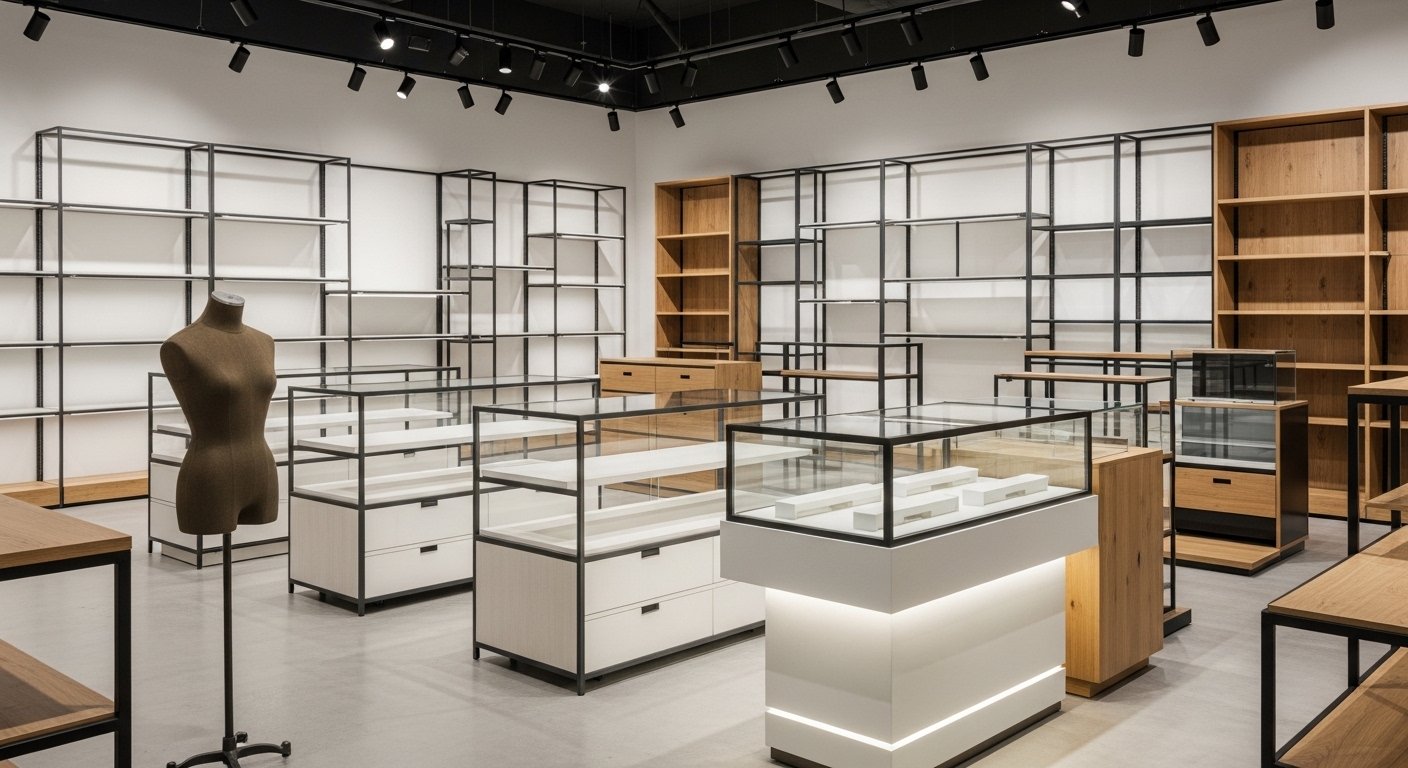
I believe that most mistakes start at the desk, not the factory floor. We use detailed engineering drawings to align design with production reality [6]. For metal components, laser cutting is often better than making molds for small batches because it is more precise and flexible [1]. When we move to the powder coating stage, we calculate the exact amount of powder needed. Our machines control the coating thickness so it does not interfere with tight assembly tolerances [1]. If a display uses PVD coating, we add an Anti-Fingerprint layer to keep it looking clean in the store [6]. We also verify that all materials meet local laws, like E0 or P2 environmental standards [1]. By checking everything from the raw steel to the final box, we save our clients from the high cost of shipping a defective product [1].
| Process Stage | Key Precision Tool | Quality Outcome |
|---|---|---|
| Metal Cutting | Laser Cutting Machine [1] | Accurate dimensions within 0.1mm |
| Surface Coating | Advanced Powder Coating [1] | Consistent thickness and no "orange peel" |
| Wood Processing | CNC Router [3] | Perfect joinery for bespoke shopfittings |
| Final Assembly | Pre-shipment Mock-up | Ensures all parts fit and hardware is correct |
Conclusion
Standardized testing and precision engineering are essential for high-quality Display Fixtures and Bespoke Shopfittings. These protocols prevent structural failure, ensure long-term durability, and protect your retail brand investment.