
Are you struggling with store designs that look amazing but cost too much to build? Finding the right balance between bespoke shopfittings and a strict budget can feel like a nightmare.
High-quality display fixtures and bespoke shopfittings are achieved by balancing flexible manufacturing techniques, like laser cutting and 3D printing, with standardized internal components. Choosing the right manufacturing hub—China for complex supply chains or Vietnam for tariff advantages—further optimizes global retail strategies and reduces long-term operational costs [1][2][5].
I have spent my entire career on factory floors and in design meetings. I know how frustrating it is when a great design fails because of high costs. If you want to stop overpaying for custom displays without losing quality, keep reading to see how I handle these challenges.
How to Balance High-Quality Customization with Cost-Efficiency in Store Fixture Production?
Small custom orders often lead to massive tooling costs. You need unique branding but cannot afford thousands in molds. This financial wall often stops great retail designs from happening [1].
To balance customization and cost, use laser cutting for metal parts under 50 units to avoid mold fees which range from $100 to $1000. For plastic or complex metal parts, 3D printing offers smooth finishes and quick delivery within 12 to 36 hours without expensive injection molds [1].
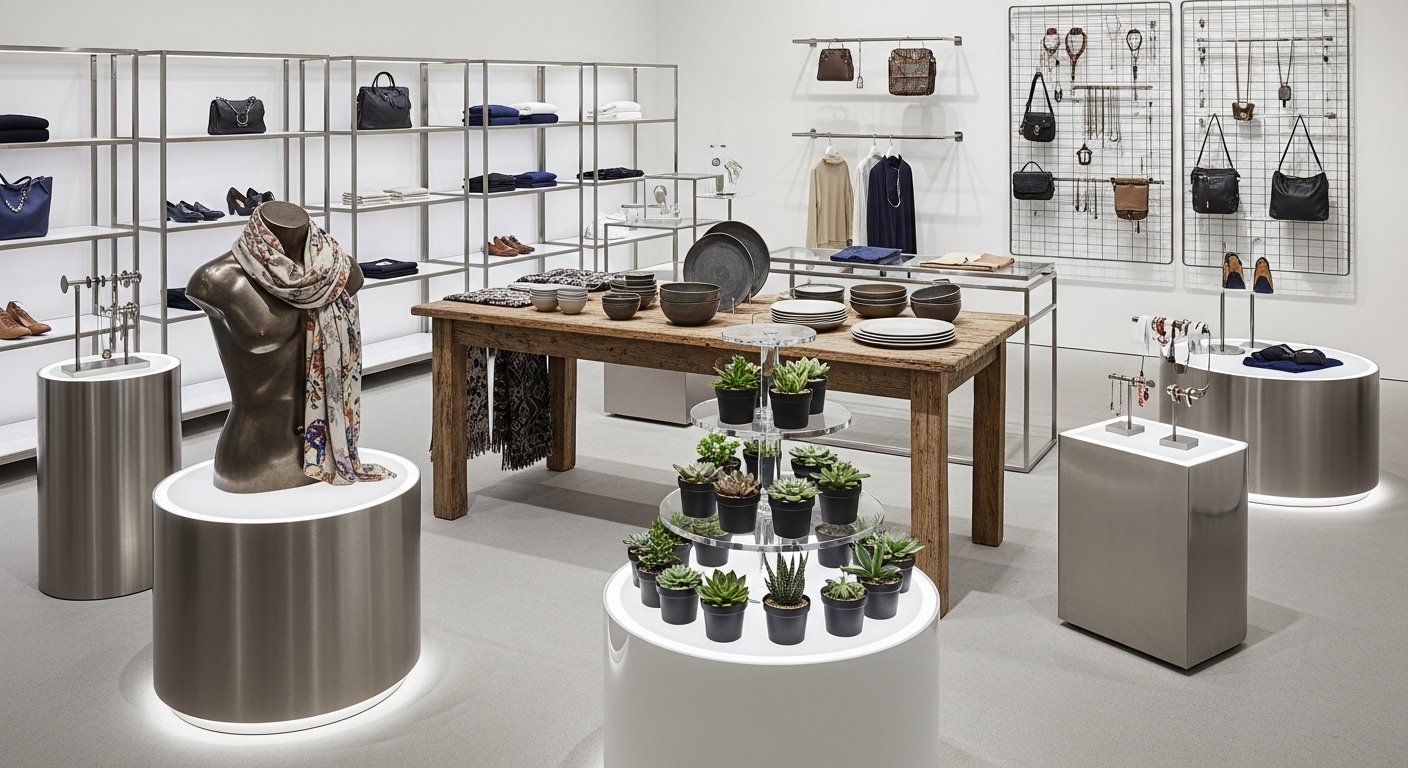
In my experience, the biggest cost in bespoke shopfittings comes from unnecessary complexity. I always tell my clients that unique branding does not require every single screw to be custom. We can use standardized internal structures, like universal uprights and shelf brackets, and only customize the visible "skin" of the fixture [1]. This approach saves money and speeds up delivery. Using Knock-down (KD) designs is another major win. Shipping a fully assembled counter is expensive because you are paying to ship air. If we design the fixture to be assembled on-site, we can save 50% to 80% on shipping container space [1][2].
We also need to choose the right materials for the right job. For example, MDF is perfect for painted finishes, while plywood is better for structures that need to hold heavy weight but might warp if you try to give it a high-gloss finish [2]. By choosing materials based on their mechanical properties rather than just their look, we reduce waste and rework.
| Material Type | Best Use Case | Strength | Finish Quality |
|---|---|---|---|
| MDF | Painting and HPL veneers | Medium | High (Smooth) |
| Plywood | Structural frames | High | Medium (Visible grain) |
| Particle Board | Internal non-load parts | Low | Low (Cost-effective) |
| Solid Wood | Luxury accents | High | High (Natural) |
I have found that the most successful projects start with a strong engineering foundation. We look at the design and ask: "Can we laser cut this instead of casting it?" If the order is small, the answer is almost always yes [1].
China vs. Vietnam: Which Manufacturing Hub Best Suits Your Global Retail Display Strategy?
Choosing the wrong country for production can lead to unexpected tariffs or supply chain delays. You need a reliable hub that fits your specific market and budget constraints perfectly [2][5].
China is best for complex, high-end bespoke shopfittings and European markets due to its complete supply chain. Vietnam is ideal for North American buyers to avoid high tariffs, provided the local value-added content exceeds 60%, though many components still come from China [2][5].
I manage production in both China and Vietnam, and they serve very different purposes. China is a powerhouse for bespoke shopfittings because the supply chain is so dense. If I need a specific LED driver, a custom acrylic bin, and a PVD-coated metal frame, I can find all of them within a few miles of my Xiamen factory [2]. This makes China the go-to for luxury brands and complex designs. However, for my clients in the USA, the tariffs on Chinese goods are a major burden.
This is where Vietnam becomes a great option. If we process the metal and wood in Vietnam, we can often qualify for lower tariffs [2]. But you must be careful. Vietnam's supply chain is still growing. Many high-end accessories still need to be shipped from China to Vietnam for final assembly [5]. I often ship custom hardware from Xiamen to our Ho Chi Minh facility to ensure the quality remains high while our clients still get the tax benefits [2].
| Feature | China Hub | Vietnam Hub |
|---|---|---|
| Supply Chain | Extremely Mature | Developing |
| Target Market | Europe, Global High-end | North America (Tariff focus) |
| Lead Times | Faster for complex items | Longer (due to material sourcing) |
| Customization | Very High | Medium to High |
I believe that for most retail designers, the choice depends on where the stores are located. If you are building a pop-up shop in London, China is the clear winner. If you are rolling out 100 stores across the USA, we should definitely talk about a Vietnam-based strategy [2].
Avoiding Hidden Risks: What Are the Key Quality Standards and Logistics Pitfalls in Overseas Sourcing?
A beautiful sample is useless if the bulk order arrives damaged or fails local safety laws. Hidden shipping fees and poor material choices can quickly turn a project profit into a loss [1][4][6].
Key risks include non-compliance with E0/P2 environmental standards and "hidden" logistics fees like inflated Terminal Handling Charges (THC). Ensure quality by aligning specifications early, using anti-fingerprint PVD coatings for metal, and verifying that wood substrates are sealed to prevent humidity-based cracking [1][3][6].
Most sourcing problems do not actually start in the factory; they start at the desk. I have seen projects fail because the drawings were not clear or the material tolerances were ignored [6]. For example, if you use man-made marble on top of an MDF cabinet without a moisture barrier, the wood will expand and crack the stone [3]. This is a simple physics problem that many people overlook. In our factory, we use advanced powder coating equipment to ensure thickness is exact, which is vital for parts that must fit together perfectly [1].
Then there is the issue of "hidden" costs. Many freight forwarders will give you a low shipping price but then charge you crazy fees for documentation or terminal handling [3][4]. I always tell my clients to check the THC (Terminal Handling Charge) and VGM (Verified Gross Mass) fees. Some agents charge $100 for a task that only costs $20 [4]. Being professional means knowing these details so you don't get cheated.
| Risk Category | Common Issue | My Solution |
|---|---|---|
| Material | MDF swelling/cracking | Use moisture-resistant boards and sealing [3] |
| Legal | Non-compliant electricals | Use UL/CE certified components [1] |
| Logistics | Inflated local fees | Audit THC and document fees against market rates [4] |
| Surface | Fingerprints on metal | Use PVD coating with Anti-Fingerprint (AF) layer [6] |
I have learned that execution fails quietly. You won't notice a mistake until the container arrives and the chairs are 2mm off-level [6]. That is why my team focuses on the "boring" details like Specification Lists and certified material standards (like E0 or P2) before we even turn on a machine [1].
Conclusion
Succeeding in retail display requires balancing smart engineering, right-site manufacturing, and strict quality standards. I am here to help you navigate these complex choices for your next project.